← Back to Course
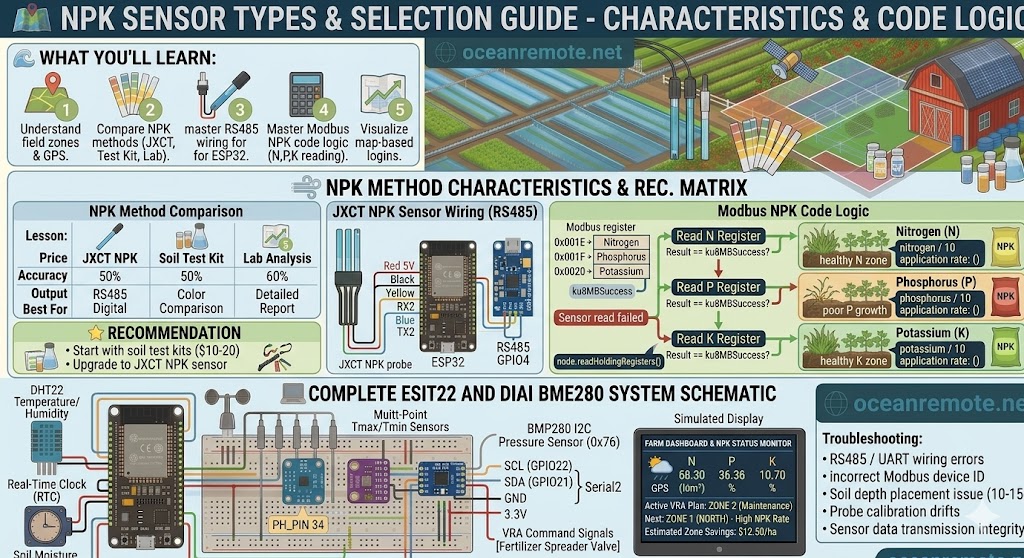
NPK Sensor Types and Selection
🔌 NPK Sensor Types and Selection Guide - Soil Nutrient Monitoring
🔌 What You'll Learn:
- 📊 Compare JXCT sensor vs soil test kit vs lab analysis
- 🔌 Wire JXCT RS485 NPK sensor to ESP32
- 📈 Read Nitrogen, Phosphorus, and Potassium values in mg/kg
- 🌾 Interpret NPK levels and fertilizer recommendations
📊 NPK Sensor Comparison
- 🔬 JXCT NPK Sensor
💰 $50-80 · 🎯 ±5% accuracy · 📡 Digital (RS485)
🌱 Best for: Continuous monitoring, 1-5 acre farms - 🧪 Soil Test Kit
💰 $10-20 · 🎯 ±20% accuracy · 📡 Color chart
🌱 Best for: Beginners, occasional spot checks - 🏫 Lab Analysis
💰 $50-100/sample · 🎯 ±2% accuracy · 📡 Detailed report
🌱 Best for: Large farms (5+ acres), annual baseline
💡 Key Insight:
The JXCT NPK sensor prevents over-fertilization, saving $150-250/year on a 2-acre farm. Payback period: 4-6 months.
🌟 Recommendation:
- Beginners: Soil test kit ($10-20) - learn the basics
- Small farms (1-5 acres): JXCT sensor ($50-80) - continuous monitoring
- Large farms (5+ acres): Lab analysis + JXCT spot checking
🔌 JXCT NPK Sensor Wiring (RS485)
JXCT NPK → RS485 Conv → ESP32
Red(VCC)  → VCC         → 5V
Black(GND) → GND        → GND
Yellow(A+) → A+         → GPIO16(RX2)
Blue(B-)   → B-         → GPIO17(TX2)

RS485 Converter → ESP32
RO → GPIO16(RX)
DI  → GPIO17(TX)
RE/DE → GPIO4 (tied together)
📖 Complete NPK Sensor Code
#include <ModbusMaster.h>

ModbusMaster npk;
#define RE_DE 4
#define RX2 16
#define TX2 17

void setup() {
    Serial.begin(115200);
    Serial2.begin(4800, SERIAL_8N1, RX2, TX2);
    pinMode(RE_DE, OUTPUT);
    digitalWrite(RE_DE, HIGH);
    npk.begin(1, Serial2);
}

void readNPK(int &n, int &p, int &k) {
    uint8_t res = npk.readHoldingRegisters(0x001E, 3);
    if (res == npk.ku8MBSuccess) {
        n = npk.getResponseBuffer(0) / 10;
        p = npk.getResponseBuffer(1) / 10;
        k = npk.getResponseBuffer(2) / 10;
    } else {
        n = p = k = -1;
    }
}

void loop() {
    int n, p, k;
    readNPK(n, p, k);

    Serial.printf("📊 NPK: %d | %d | %d mg/kg\n", n, p, k);

    if (n < 100) Serial.println("   🌿 N: LOW → Apply 20kg/ha nitrogen");
    else if (n > 250) Serial.println("   🌿 N: HIGH → Reduce by 30%");
    else Serial.println("   🌿 N: OPTIMAL");

    if (p < 20) Serial.println("   🌸 P: LOW → Apply 10kg/ha phosphorus");
    else if (p > 60) Serial.println("   🌸 P: HIGH → Reduce by 25%");
    else Serial.println("   🌸 P: OPTIMAL");

    if (k < 150) Serial.println("   🍌 K: LOW → Apply 15kg/ha potassium");
    else if (k > 300) Serial.println("   🍌 K: HIGH → Reduce by 20%");
    else Serial.println("   🍌 K: OPTIMAL");

    delay(60000);
}
💡 Optimal NPK Ranges:
- Nitrogen (N): 150-250 mg/kg — Low = yield drop 15-25%
- Phosphorus (P): 30-60 mg/kg — Low = poor root/flowering
- Potassium (K): 150-300 mg/kg — Low = weak disease resistance
⚠️ Important Notes:
- JXCT sensor needs external 24V power (not from ESP32!)
- Insert to 10-15cm depth (active root zone)
- Take 3-5 readings at different spots, then average
- Calibrate with distilled water before first use
- Clean probe after each use with soft brush + distilled water
📖 Case Study — $800/Year Savings with NPK Sensor:
A 10-acre vegetable farm installed JXCT sensors in 3 zones:
- 📊 Discovered: Zone 2 N was 280 mg/kg (EXCESS) — over-fertilizing for 3 years
- ✅ Action: Reduced N application by 50% in Zone 2
- 💰 Savings: $800/year in fertilizer costs
- 📈 Yield: Same yield (no loss) + 12% less nitrate leaching
"The sensor paid for itself in 4 months. I'll never guess fertilizer rates again!" — Farm manager, Kenya
🎉 Key Takeaways:
- ✅ NPK sensor pays for itself in 4-6 months (saves $150-250/year/acre)
- ✅ Optimal N: 150-250 mg/kg, P: 30-60 mg/kg, K: 150-300 mg/kg
- ✅ RS485 sensors need external 24V power supply
- ✅ Take multiple readings and average for ±5% accuracy
- ✅ Using sensor data can reduce fertilizer use by 20-40%
💡 Key Takeaways:
- Apply these concepts directly to your farm or project.
- Take notes on important details for the quiz.
- Use the button below to track your progress.
×
![Enlarged view]()